I. From the Perspective of the Product Itself
(I) Specification Parameters
YJV32 0.6/1kV
Power Cable complies with the 60502 standard, covering various specifications from 4×16mm² to 4×185mm², all with a 4-core structure and a rated voltage of 0.6/1kV, suitable for medium and low voltage distribution systems.
Cables of different specifications vary in parameters such as current-carrying capacity, outer diameter, and bending radius. For the 4×16mm² specification cable, the long-term allowable current-carrying capacity is approximately 80A when laid in air and about 90A when laid in soil. The outer diameter of the cable is about 28mm, with a static bending radius of not less than 10 times the cable outer diameter and a dynamic bending radius of not less than 15 times the cable outer diameter. For the 4×25mm² specification cable, the current-carrying capacity in air is about 105A, and in soil is about 115A, with an outer diameter of about 32mm, and the bending radius requirements are consistent with the 4×16mm² specification.
For the 4×35mm² specification cable, the current-carrying capacity in air is about 130A, and in soil is about 145A, with an outer diameter of about 36mm, a static bending radius of not less than 12 times the cable outer diameter, and a dynamic bending radius of not less than 20 times. For the 4×50mm² specification, the current-carrying capacity in air is about 160A, and in soil is about 180A, with an outer diameter of about 40mm, and the bending radius is the same as that of the 4×35mm² specification.
For the 4×70mm² specification, the current-carrying capacity in air is about 195A, and in soil is about 220A, with an outer diameter of about 45mm; for the 4×95mm² specification, the current-carrying capacity in air is about 230A, and in soil is about 260A, with an outer diameter of about 50mm; for the 4×120mm² specification, the current-carrying capacity in air is about 265A, and in soil is about 300A, with an outer diameter of about 55mm; for the 4×150mm² specification, the current-carrying capacity in air is about 295A, and in soil is about 335A, with an outer diameter of about 60mm; for the 4×185mm² specification, the current-carrying capacity in air is about 330A, and in soil is about 375A, with an outer diameter of about 68mm. The static bending radius of these specifications is not less than 12 times the cable outer diameter, and the dynamic bending radius is not less than 20 times.
(II) Characteristic Uses
4×16mm²-4×50mm² Specifications
These small-sized cables are suitable for building branch lines and small equipment power distribution. In commercial buildings, they can be used as branch lines to distribute power from the main distribution trunk line to distribution boxes on each floor, supplying power to small electrical equipment such as office lighting, computers, and printers. Small machine tools, small fans, and other equipment in small factories, with relatively low power, can also use these specifications of cables for power distribution to ensure stable operation of the equipment.
4×70mm²-4×185mm² Specifications
Large-sized cables can meet the needs of industrial workshop main lines and outdoor engineering power distribution. The main lines of large production workshops need to transmit large currents. These cables can transmit power from the workshop power distribution room to distribution boxes in various production areas, providing power support for large machine tools, production lines, and other equipment. In outdoor projects, such as road construction and bridge construction, these cables can be used as main power distribution lines, adapting to complex outdoor environments and supplying power to mechanical equipment and temporary lighting systems in the projects.
In addition, scenarios such as the main lines of street lamp systems in municipal engineering and the main power distribution lines of large shopping malls also often use these large-sized cables to ensure stable power transmission.
(III) Material and Style
Conductor Material
The
Cable Conductor is made of pure copper with a purity of more than 99.95%. High-purity copper has excellent conductivity, which can reduce resistance, reduce energy loss during power transmission, and improve power transmission efficiency. At the same time, pure copper has good ductility and mechanical strength, and is not easy to break during the production, transportation, installation, and use of the cable, which can ensure the structural stability of the cable and the reliability of its conductive performance.
Insulation Layer Material
The insulation layer is made of cross-linked polyethylene (XLPE) material. After cross-linking treatment, XLPE forms a three-dimensional network structure, which gives it excellent temperature resistance and allows it to work stably for a long time at a high temperature of 90℃. Compared with traditional polyethylene, XLPE has higher insulation resistance, which is stable above 1000MΩ under 0.6/1kV voltage, lower dielectric loss, and better insulation performance, which can effectively block current and prevent electric leakage and short-circuit accidents. In addition, XLPE also has good anti-aging performance and chemical stability, can resist the erosion of various chemical substances, and extend the service life of the cable.
Armoring Layer Material
The steel wire armoring (Swa) layer is made of high-carbon steel wires treated with galvanization. High-carbon steel wires have high mechanical strength and toughness. After galvanization treatment, their corrosion resistance is greatly improved, and they can adapt to complex environments such as humidity and dust. The armoring layer is tightly wound around the outer layer of the cable, which significantly improves the cable's impact resistance, compressive strength, and tensile capacity, enabling the cable to adapt to harsh laying conditions such as direct burial and cable trays, and effectively protecting the internal structure from external damage.
Sheath Material
The outer sheath is made of polyvinyl chloride (PVC) material. The
PVC Sheath has good moisture-proof and anti-corrosion properties, which can protect the armoring layer and internal structure from erosion by moisture, dust, chemical substances, etc. At the same time, PVC material has certain flame-retardant properties, which can delay the spread of fire in case of fire, further ensuring the safety of the cable.
Style Design
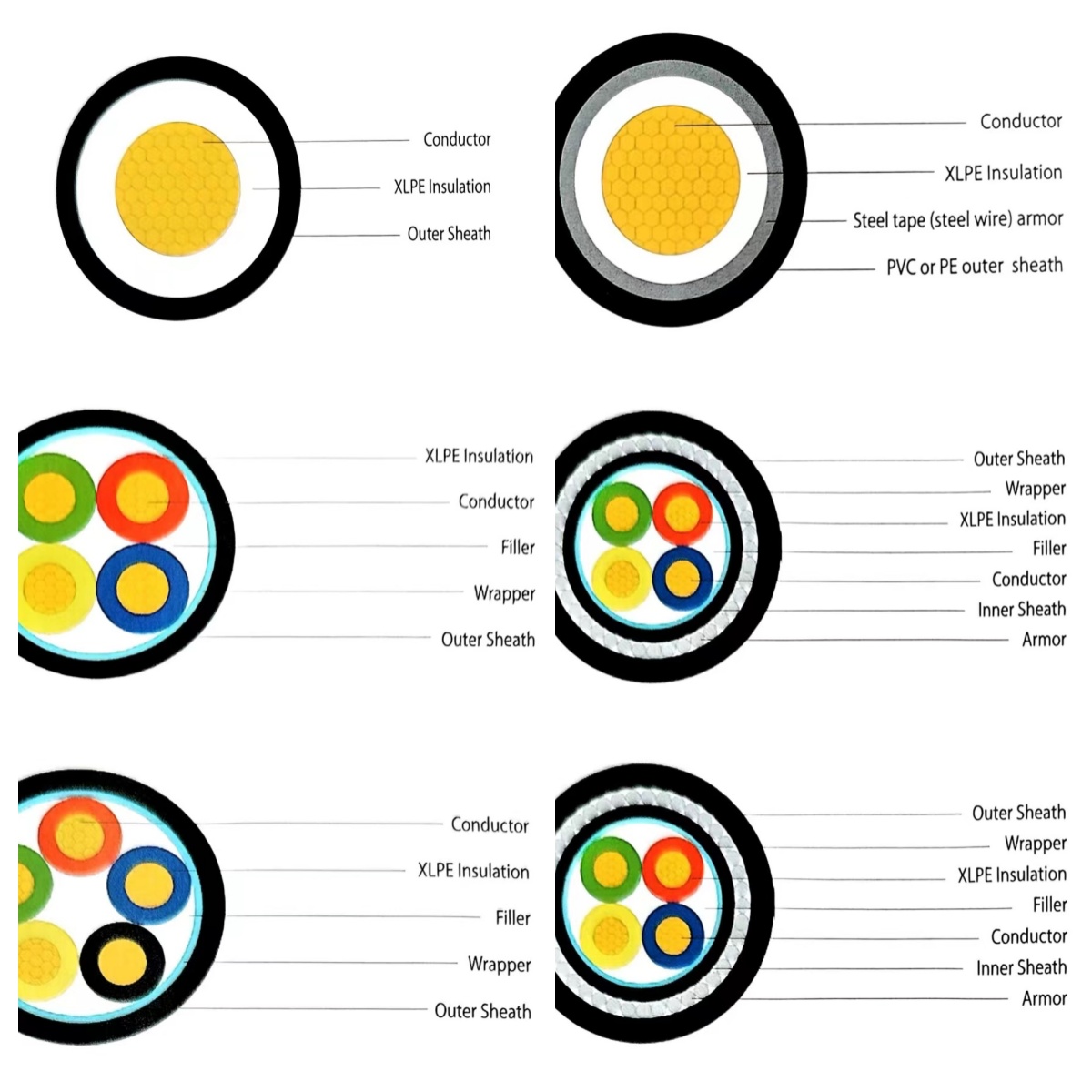
The cable is cylindrical in overall shape, with distinct structural layers, from the inside to the outside, which are
Pure Copper Conductor, XLPE insulation layer, filling material, tape layer, steel wire armoring layer, and PVC sheath. The filling material is an inert material, such as polypropylene rope, which is used to fill the gaps between conductors to ensure the roundness of the cable. The tape layer is made of non-woven fabric or polyester tape, which plays a role in fixing and protecting the internal structure. The surface of the cable is smooth and flat, and the color is usually black. Black has good dirt resistance and concealment, and can maintain a relatively stable appearance in various laying environments.
(IV) Production Process
Conductor Production
First, high-purity copper ingots are smelted to remove impurities, obtaining copper water that meets the purity requirements. Then, the copper water is cast into copper rods through a continuous casting process, and the diameter of the copper rods is accurately adjusted according to the specifications of the cable conductor. Next, the copper rod is drawn into
Copper Wires of the required diameter by a wire drawing process. During the wire drawing process, the drawing speed, temperature, and lubrication conditions are strictly controlled to ensure the dimensional accuracy and mechanical properties of the copper wires. After that, multiple copper wires are stranded according to a certain stranding method to form conductors with different cross-sectional areas. During the stranding process, the tightness and roundness of the conductor must be ensured to improve the conductivity and mechanical strength of the conductor.
Insulation Layer Extrusion
The extrusion molding process is used to wrap the XLPE insulation layer around the conductor. First, XLPE granular material is added to the hopper of the extruder. After being heated and melted, the molten XLPE material is transported to the mold through the screw of the extruder. The size of the mold is accurately designed according to the cable specifications to ensure uniform thickness of the insulation layer. During the extrusion process, the extrusion temperature (generally between 180-200℃), extrusion speed, and pressure are strictly controlled to make the molten XLPE material evenly coat the surface of the conductor to form a continuous and dense insulation layer. After extrusion, the insulation layer is cross-linked, usually by warm water cross-linking or steam cross-linking, so that the XLPE molecules form a three-dimensional network structure, thereby improving its temperature resistance and insulation performance.
Cabling Process
The 4
Insulated Wire cores are subjected to cabling treatment. During the cabling process, the four insulated wire cores are stranded together according to a certain stranding direction and pitch. The stranding pitch is reasonably set according to the cable specifications to ensure the
Flexibility and structural stability of the cable. At the same time, inert filling materials, such as polypropylene rope, are filled between the conductors to ensure the roundness and filling rate of the cable and reduce friction and extrusion between conductors. After cabling, a layer of non-woven fabric or polyester tape is wrapped around the outside as a tape layer, which plays a role in fixing and protecting the internal structure.
Steel Wire Armoring
The steel wire armoring is applied outside the tape layer by the wrapping process. The galvanized high-carbon steel wires are wrapped around the outer layer of the cable at a certain angle and tension through a special armoring machine. The diameter and wrapping pitch of the steel wire are accurately calculated according to the cable specifications to ensure the tightness and uniformity of the armoring layer. During the armoring process, it is necessary to ensure that the steel wires are arranged neatly, avoiding overlapping or gaps, to enhance the mechanical strength and impact resistance of the cable.
Sheath Extrusion
A PVC sheath is extruded outside the steel wire armoring layer. PVC granular material is added to the extruder, heated and melted, and then evenly coated on the surface of the armoring layer through an extrusion mold. The extrusion parameters are controlled to ensure that the sheath has uniform thickness, a smooth surface, and is closely combined with the armoring layer without defects such as bubbles and impurities. The extrusion of the sheath can further protect the cable from external environmental erosion and improve the safety and service life of the cable.
Quality Inspection
Strict quality inspection is carried out in each link of the production process. For the conductor, parameters such as its diameter, resistivity, and tensile strength are tested to ensure that its conductivity and mechanical properties meet the standard requirements; for the insulation layer, properties such as its thickness, insulation resistance, voltage resistance, and temperature resistance are tested to ensure its insulation effect and stability; for cabling, steel wire armoring, and sheath, parameters such as their appearance quality, dimensional accuracy, and mechanical strength are tested to ensure the structural stability and effectiveness of their protective role. The finished cable also needs to undergo partial discharge tests, aging tests, bending tests, etc., to comprehensively inspect the performance of the cable. Only cables that pass all tests and comply with the 60502 standard can leave the factory for sale.
II. From the Perspective of General Product Information
(I) Packaging
Packaging Materials
According to the specifications and lengths of the cables, appropriate packaging materials are selected. Cables of 4×16mm²-4×50mm² specifications, due to their relatively small cross-sectional area and light weight, can be packaged with wooden cable reels. Wooden cable reels have relatively low cost and light weight, suitable for medium and short-distance transportation and small-batch delivery. Cables of 4×70mm²-4×185mm² specifications have larger cross-sectional areas and heavier weights, and are usually packaged with steel cable reels. Steel cable reels have high strength and strong bearing capacity, which can well protect the cables from damage during transportation and storage, and are suitable for long-distance transportation and packaging of long-length cables.
Packaging Method
When packaging, the cable is neatly wound on the cable reel, arranged tightly and flatly, avoiding twisting, crossing, and overlapping, so as to prevent the cable from being squeezed and worn during transportation and storage. The outermost layer of the cable is wrapped with a plastic film, which has good moisture-proof and dust-proof performance and can protect the cable from pollution by the external environment. The sides of the cable reel are equipped with firm baffles to prevent the cable from slipping. For steel cable reels, metal baffles are used, and for wooden cable reels, wooden baffles are used to ensure the stability of the cable during transportation and storage. A shaft sleeve is installed at the central shaft hole of the cable reel to facilitate handling and loading/unloading with equipment such as forklifts and cranes.
Packaging Marks
Relevant product information is clearly and firmly marked on the side and end face of the cable reel, including product name (YJV32 0.6/1kV Power Cable), specification parameters (4×16mm² to 4×185mm²), length, rated voltage, implementation standard (60502 standard), production date, production batch number, manufacturer's name, address, contact information, etc. These marks facilitate users to identify product information when receiving and inspecting the cable, and are also conducive to product traceability and quality management.
(II) Transportation
Transportation Mode
According to the transportation distance, quantity of cables, and customer needs, a suitable transportation mode is selected. For medium and short-distance transportation with small batches, road transportation is adopted. Road transportation has high flexibility and can realize door-to-door service, facilitating customers to receive goods. For long-distance transportation or large-batch delivery, railway transportation can be used. Railway transportation has large transport capacity, low cost, and stable transportation process, which can effectively ensure the safety of the cable. For urgent orders, car express transportation can also be used to shorten the transportation time and ensure the timely delivery of goods.
Transportation Precautions
Before transportation, carefully check the packaging of the cable to ensure that the cable reel is intact, the cable is tightly wound, and the plastic film is tightly wrapped. During transportation, the cable reel must be placed horizontally, and tilting, inverting, or stacking are strictly prohibited to prevent the cable reel from rolling and colliding, which may cause damage to the cable. The transport vehicle should drive smoothly, avoiding violent operations such as sudden braking and sharp turns, to reduce the shaking of the cable reel. At the same time, measures should be taken to prevent rain, sun, and moisture. A rain cloth can be covered on the cable reel to avoid the cable being soaked by rain, exposed to the sun, or damp, which may affect the performance of the cable. When loading and unloading the cable, special lifting equipment such as cranes and forklifts must be used. During loading and unloading, handle with care to avoid impact and damage to the cable and cable reel.
Transportation Fixation
To prevent the cable reel from moving and rolling during transportation, it is necessary to fix it firmly. Steel wire ropes, iron chains, etc. can be used to tightly fix the cable reel on the carriage of the transport vehicle. The fixed points should be selected at the solid parts of the cable reel, such as the flange of the steel reel or the reinforcing rib of the wooden reel, to ensure reliable fixation. For long-distance transportation, buffer materials such as wooden boards and rubber pads can also be placed between the cable reels to reduce mutual collision and friction between the cable reels and further protect the cable.
(III) Delivery
Delivery Process
After the customer places an order and makes payment, the sales department will promptly transmit the order information to the warehouse and production department. Warehouse personnel prepare goods according to the order information. For stock products, it is necessary to carefully check whether the specifications and quantity of the products are consistent with the order; for customized products, the production department organizes production according to the order requirements. After production is completed, the products are inspected by the quality inspection department and then transferred to the warehouse. After packaging the products, the warehouse personnel contact the transportation company to determine the transport vehicle, transportation route, and transportation time. Before delivery, the delivery information, such as the name of the transportation company, license plate number, waybill number, estimated arrival time, etc., is promptly informed to the customer to facilitate the customer's preparation for receiving the goods.
Delivery Time
For conventional specification cables in stock, delivery will generally be completed within 1-3 working days after receiving the customer's order and confirming payment. For cables that need to be produced according to the customer's special requirements, the delivery time will be determined according to the production cycle, usually 7-15 working days. The specific delivery time will be communicated and confirmed with the customer in advance, so that the customer can clearly understand the production progress and estimated delivery time of the goods.
Delivery Tracking
After the cable is delivered, the company will track the transportation status of the goods throughout the process. By maintaining close contact with the transportation company, timely obtain information such as the location and transportation progress of the goods. If there are abnormal situations during transportation, such as traffic jams, bad weather, etc., which cause transportation delays, the customer will be notified immediately, and active coordination with the transportation company will be made to try to shorten the delay time and ensure that the goods can be delivered to the customer as soon as possible.
(IV) Samples
Sample Provision
To allow customers to better understand the quality, performance, and appearance of YJV32 0.6/1kV
Power Cables, the company can provide samples of various specifications. Customers can choose samples of corresponding specifications according to their own needs. The length of the sample is generally 1-2 meters, which can meet the customer's inspection of the conductor material, insulation layer, armoring layer, sheath quality, and structural design of the cable.
2.
Sample Costs
The samples themselves are provided to customers free of charge, but customers are required to bear the express delivery fees for the samples. For large customers with clear cooperation intentions or long-term partners, the company will reduce or waive the express delivery fees of the samples according to the actual situation to promote cooperation between the two parties.
Sample Delivery
Upon receiving the customer's request for samples, the company will prepare the samples within 1-2 working days and package them properly. During packaging, the specification parameters and other information will be clearly marked on the samples to prevent damage or confusion during transportation. Then, the samples will be sent to the customer via a reliable express method, and the express tracking number will be promptly informed to the customer to facilitate the customer's inquiry about the transportation status of the samples.
(V) After-sales Service
Quality Assurance
The company promises that the YJV32 0.6/1kV power cables produced and sold comply with the 60502 standard as well as relevant national standards and industry norms, with a product quality warranty period of 1-3 years. Within the quality warranty period, if the cable has quality problems caused by non-human factors, such as aging of the insulation layer, damage to the sheath, or breakage of the conductor, the company will provide free repair or replacement services for the customer.
Technical Support
The company has a professional technical team to provide customers with comprehensive technical support. If customers encounter any technical problems during the installation, laying, or use of the cable, they can contact the technical personnel at any time through phone calls, emails, online consultations, etc. The technical personnel will promptly provide detailed answers and professional guidance. For some complex technical issues, the company can arrange technical personnel to go to the site for guidance and assistance to ensure the installation quality and normal use of the cable.
Fault Handling
If customers find that the cable has faults during use, they should notify the company in a timely manner. After receiving the notification, the company will respond within 24 hours, arrange professional personnel to communicate with the customer, understand the specific situation of the fault, analyze the cause based on the fault phenomenon, and formulate a solution. For faults that require on-site handling, technical personnel will be dispatched to the site for repair or replacement as soon as possible to minimize the losses caused by cable faults to the customer.
Customer Feedback
The company attaches great importance to customers' feedback and has set up various customer feedback channels, such as customer service hotlines, email addresses, and online message boards. Any problems encountered or suggestions put forward by customers during the use of the products can be fed back to the company through these channels. The company will arrange special personnel to sort out, analyze, and handle customers' feedback and reply to customers within a specified time. At the same time, the company will continuously improve product quality and service levels according to customers' feedback to enhance customer satisfaction.
In summary, YJV32 0.6/1kV power cables have significant advantages in terms of specification parameters, characteristic uses, material styles, and production processes, and can meet the needs of various medium and low voltage distribution scenarios such as building branch lines, industrial workshop main lines, and outdoor engineering. At the same time, comprehensive services including packaging, transportation, delivery, samples, and after-sales provide customers with all-round guarantees, making them an ideal choice for medium and
Low Voltage Power transmission.


 Español
 Portugues
 Pусский
 Français
 العربية
 ไทย
ไทย Türk dili
 Indonesia
 Tiếng Việt



 Phone
Phone E-mail