I. From the Perspective of the Product Itself
(1) Specification Parameters
The 0.6/1kV low-voltage underground
Multi-Core cable (model N2xy) has a specification of 3×240+1×120mm², which clearly defines the structural composition of the cable. Among them, "3×240" indicates 3 main cores with a cross-sectional area of 240mm², and "1×120" represents 1 neutral core with a cross-sectional area of 120mm². This multi-core structure design can meet the needs for power distribution and circuit balance in underground power transmission.
In terms of voltage level, the cable is suitable for 0.6/1kV low-voltage power distribution systems, which means it can operate stably in power networks with a rated voltage of 600V and a maximum voltage of 1000V, complying with the standards for general civil and industrial low-voltage electricity usage.
Current-carrying capacity is an important parameter to measure the transmission capacity of the cable, and the current-carrying capacity of this cable can reach 400-500A. This range of current-carrying capacity enables it to meet the power distribution needs of underground main lines in places such as residential communities and industrial parks, and can carry the daily electricity load of a large number of residents or enterprises.
The conductive performance parameters of the conductor are crucial. High-purity
Copper Conductors have a conductivity of 58MS/m. This excellent conductivity can effectively reduce losses during power transmission, improve energy utilization efficiency, and is suitable for occasions with high energy efficiency requirements.
Aluminum Conductors have a conductivity of about 37MS/m, which, although slightly inferior to
Copper Conductors, can also meet basic power transmission needs in medium and low-load scenarios.
The performance parameters of the insulation layer are also not to be ignored. The XLPE (cross-linked polyethylene) insulation layer, after cross-linking treatment, has a temperature resistance range extended to -40℃ to 90℃, which allows the cable to maintain stable insulation performance in different underground temperature environments. Its insulation resistance is ≥1000MΩ·km, and the breakdown field strength is ≥20kV/mm, which can effectively resist the impact of underground humidity, corrosion and other factors, ensuring the safety of power transmission.
In terms of the sheath layer, the PVC (polyvinyl chloride) sheath complies with the GB/T 2951.5 standard, has certain mechanical strength and chemical corrosion resistance, and can provide good protection for the internal structure of the cable.
(2) Characteristic Uses
This cable is specially designed for underground laying scenarios, with many characteristic uses and plays an important role in various fields.
In residential communities, it can be used as an underground main line, responsible for transmitting power from substations or distribution rooms to the distribution boxes of each building, providing stable support for residents' daily electricity usage. With a current-carrying capacity of 400-500A, it can meet the needs of more than 500 households using various electrical equipment at the same time, such as air conditioners, refrigerators, and televisions, and operates stably and reliably. This has been verified by the practical application case in a large residential community, which has been in operation for 5 years without failure.
In industrial parks, this cable can be used to connect the underground power network of various factories and production equipment. There are usually various small and medium-sized industrial equipment in industrial parks, and the demand for electricity is relatively stable. The aluminum conductor version of the cable is widely used in medium and low-load industrial park scenarios due to its cost advantage; for some precision manufacturing enterprises with high energy efficiency requirements, the copper conductor version of the cable is more suitable, which can reduce power transmission losses and ensure the stable operation of equipment.
In addition, the cable is also suitable for underground power distribution systems in municipal engineering, such as power supply for urban road lighting, underground parking lots and other places. In these scenarios, the cable needs to be buried underground for a long time, withstanding certain pressure and environmental impacts. The acid and alkali resistance, mechanical wear resistance of its
PVC Sheath and the specific protective design of the N2xy model can ensure the long-term stable operation of the cable.
(3) Material and Style
Material
There are two choices for
Conductor Materials: copper (Cu) and aluminum (Al). High-purity copper conductors have excellent conductivity and good ductility, and can enhance
Flexibility through stranding technology, facilitating laying in complex underground environments. At the same time, copper has good chemical stability and is not easy to be corroded, which can ensure the long service life of the cable.
Aluminum Conductors are lightweight, with a density of only about 1/3 of that of copper, which reduces the overall weight of the cable and lowers the labor intensity during transportation and laying. In addition, the cost of aluminum is relatively low, which can reduce the overall cost of the project to a certain extent, but the corrosion resistance of aluminum is slightly poor. In humid and highly corrosive underground environments, certain anti-corrosion measures need to be taken.
The insulation layer is made of XLPE (cross-linked polyethylene) material. XLPE is a polyethylene that has undergone cross-linking treatment, and its molecular structure forms a three-dimensional network structure. Compared with ordinary polyethylene, it has higher heat resistance, mechanical strength and insulation performance. This material can resist high temperature, humidity and chemical corrosion in the underground environment, ensuring the long-term stability of the cable's insulation effect.
The sheath layer is made of PVC (polyvinyl chloride) material. PVC has good acid and alkali resistance, mechanical wear resistance and certain flame retardancy, which can effectively protect the internal conductors and insulation layers of the cable from external environmental damage. At the same time, PVC materials are relatively inexpensive and have mature processing technology, making them suitable for mass production.
Style
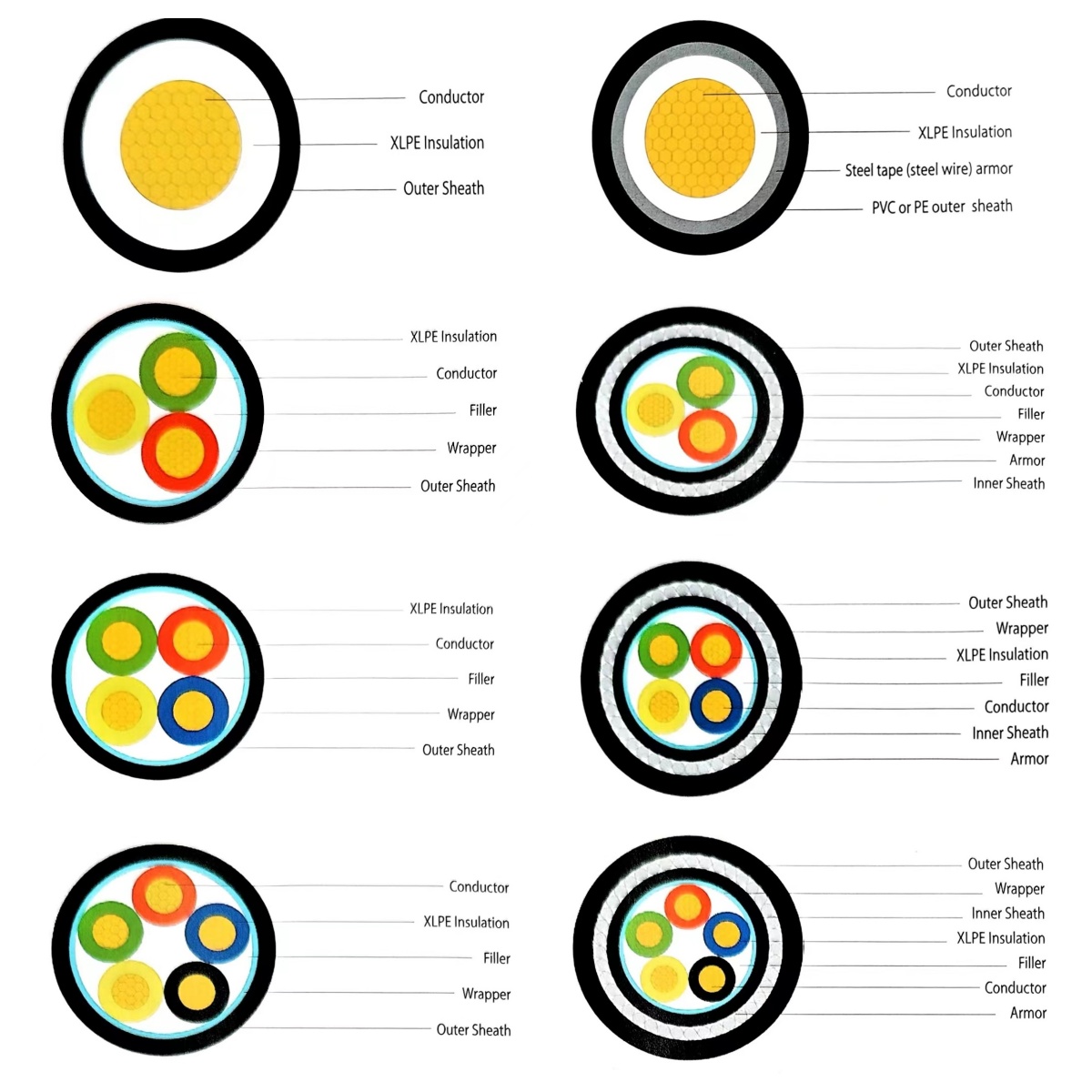
The cable has a multi-core structure, with 3 main cores and 1 neutral core twisted together, wrapped with an insulation layer and a sheath layer, presenting an overall cylindrical long strip shape. This structural design makes the cable have good flexibility and tensile performance, facilitating laying operations such as bending and dragging underground.
The color of the cable is usually black. The black sheath can effectively absorb sunlight heat, reduce the impact of temperature changes on the cable, and also has good weather resistance, suitable for long-term burial underground or exposure to outdoor environments. On the surface of the cable, there are usually marking information such as model, specification, voltage level, and manufacturer, which is convenient for users to identify and inspect.
(4) Production Process
The production process of this cable is rigorous and complex, ensuring the quality and performance of the product.
Conductor Production: For copper conductors, first, high-purity copper raw materials are smelted to remove impurities and improve the purity of copper. Then, the copper liquid is cast into copper rods through a continuous casting process, and then the copper rods are drawn into Copper Wires of the required diameter through wire drawing equipment. Finally, multiple copper wires are twisted together according to a certain stranding method to form conductors with cross-sectional areas of 240mm² and 120mm². The stranding process can enhance the flexibility and mechanical strength of the conductor, facilitating subsequent processing and laying. For aluminum conductors, the production process is similar to that of copper conductors. First, aluminum raw materials are smelted and cast into aluminum rods, then drawn and twisted to form conductors of the required specifications.
Insulation Layer Extrusion: The produced conductor is cleaned and dried to remove oil and impurities on the surface. Then, an extrusion process is used to wrap a layer of XLPE Insulation Material around the conductor. During the extrusion process, it is necessary to accurately control the temperature, pressure and speed of the extruder to ensure that the insulation layer has uniform thickness, smooth surface, and is closely combined with the conductor. After extrusion, the insulation layer is cross-linked, usually by warm water cross-linking or steam cross-linking, so that the XLPE molecules form a three-dimensional network structure, thereby improving its heat resistance, insulation and mechanical strength.
Cabling: 3 main cores wrapped with insulation layers and 1 neutral core wrapped with insulation layers are twisted according to a certain lay length to form a cable core. During the stranding process, some insulation materials, such as polypropylene ropes, need to be filled in the gaps of the cable core to ensure the roundness and structural stability of the cable.
Sheath Extrusion: A layer of PVC sheath is wrapped around the cabled core by extrusion process. During the extrusion process, the parameters of the extruder should be controlled to ensure that the sheath has uniform thickness, flat surface, and is closely combined with the cable core. The extrusion of the PVC sheath can provide good mechanical protection and environmental resistance for the cable.
Finished Product Inspection: The produced cables need to undergo strict inspection. The inspection items include the DC resistance of the conductor, the insulation resistance and breakdown field strength of the insulation layer, the thickness and mechanical properties of the sheath, and the overall appearance of the cable. Only cables that pass all inspection items can leave the factory for sale, ensuring that the products meet relevant standards and user requirements.
II. From the Perspective of General Product Information
(1) Packaging
In order to ensure that the cable is not damaged during transportation and storage, its packaging method is carefully designed.
The cable is usually packaged with cable reels, which are available in wooden and iron types. For short-distance transportation or small batches of cables, wooden cable reels can be used. Wooden cable reels are light in weight and low in cost, but their load-bearing capacity is relatively weak. For long-distance transportation or large batches of cables, iron cable reels are more suitable. Iron cable reels have high strength and large load-bearing capacity, and can better protect the cables from extrusion and collision.
When packaging, the cable is neatly wound on the cable reel to avoid twisting and knotting. Then, a layer of plastic film is wrapped around the outer layer of the cable. The plastic film can play a role in moisture-proof and dust-proof, protecting the surface of the cable from pollution. For cables that need to be stored for a long time, a layer of linen or canvas can be wrapped around the outer layer of the plastic film to enhance the protection of the cable and prevent the cable from direct sunlight, rain soaking and mechanical damage.
A label is fixed on the side of the cable reel, which details the cable's model, specification, length, voltage level, manufacturer, production date and other information, facilitating users' identification and verification during receipt and storage.
(2) Transportation
The transportation of cables needs to follow certain norms and requirements to ensure the quality and safety of the cables.
In terms of transportation methods, appropriate transportation tools can be selected according to the transportation distance and quantity. Short-distance transportation can use truck transportation, which has high flexibility and can directly deliver the cables to the destination. For long-distance transportation, railway transportation or waterway transportation can be chosen. Railway transportation and waterway transportation have large capacity and relatively low cost, suitable for transporting large quantities of cables.
During transportation, attention should be paid to protecting the cables to avoid extrusion, collision, direct sunlight and rain soaking. When loading cables, the cable reels should be placed stably on the transportation tool and firmly fixed with ropes or other fixing devices to prevent rolling or tilting during transportation. For exposed parts of the cable, covering protection should be taken to avoid damage from the external environment.
During transportation, traffic rules should be observed, transportation routes and time should be reasonably arranged, and severe weather and traffic jam sections should be avoided to ensure that the cables can be delivered to the destination on time and safely.
(3) Delivery
The delivery process of cables is standardized and orderly to ensure that customers can receive qualified products in a timely manner.
After a customer places an order, the sales staff will timely confirm the order information with the customer, including the cable's model, specification, quantity, delivery date, delivery location, etc. After confirmation, the warehouse department is notified to prepare the goods. Warehouse staff retrieve the corresponding cables from the inventory according to the order requirements, and conduct appearance inspection and quantity verification of the cables.
Before delivery, quality inspectors will conduct sampling inspections on the cables to be delivered to ensure that the quality of the cables meets relevant standards and customer requirements. After passing the inspection, the cables are packaged, and the customer name, order number, product information and other contents are marked on the package.
Then, contact the logistics company to arrange for transport vehicles to pick up the goods. Warehouse staff and logistics company staff jointly check the quantity and information of the cables, go through the handover procedures, and sign the transportation contract. The logistics company transports the cables to the customer's designated delivery location according to the agreed transportation route and time.
After delivery, the sales staff will promptly notify the customer of the delivery information, including the logistics company name, transportation order number, estimated arrival time, etc., to facilitate the customer to track the transportation status of the goods.
(4) Samples
To allow customers to better understand the performance and quality of the cable, the enterprise provides sample services.
Customers can apply for samples from the enterprise by phone, email, online platform, etc., indicating the model, specification, quantity and other information of the required samples. After receiving the application, the enterprise's sales staff will communicate with the customer in a timely manner to confirm the sample details and delivery address.
Samples are produced in strict accordance with the production process and quality standards of formal products to ensure that the performance and quality of the samples are consistent with bulk products. After the samples are produced, they are inspected by the quality inspection department, and then sent to customers after simple packaging.
Sample fees are usually borne by the customer, including the production cost and transportation cost of the samples. If the customer subsequently signs a bulk order, the enterprise may appropriately reduce or waive the sample fee according to the order amount.
(5) After-sales Service
The enterprise provides customers with perfect after-sales service to protect the legitimate rights and interests of customers.
Quality Assurance: The enterprise promises that the quality of the sold cables meets relevant national standards and industry standards, and the product warranty period is 12 months from the date of delivery. During the warranty period, if the cable cannot be used normally due to its own quality problems, the enterprise will provide free repair or replacement services for the customer.
Technical Support: Customers can contact the enterprise's technical support department at any time if they encounter any technical problems during the installation, use and maintenance of the cable. Technical personnel will provide professional technical guidance to customers by phone, email, video, etc., answer customers' questions, and help customers solve practical problems. For complex technical problems, the enterprise can arrange technical personnel to provide on-site guidance.
Fault Handling: If the cable fails during use, the customer can call the enterprise's after-sales service hotline to report the fault. After receiving the report, after-sales service personnel will respond in a timely manner, understand the fault situation, and arrange professional maintenance personnel to go to the site for handling. Maintenance personnel will inspect and diagnose the faulty cable, determine the cause of the fault, and take corresponding maintenance measures to restore the normal operation of the cable as soon as possible.
Customer Feedback: The enterprise attaches great importance to customers' feedback, and has set up special customer feedback channels, such as suggestion boxes, complaint hotlines, online messages, etc. Customers can put forward opinions and suggestions on product quality, service attitude, delivery date, etc. The enterprise will promptly handle and improve the problems feedback by customers, and continuously improve product quality and service level.
Return and Exchange Policy: If the cable received by the customer has quality problems or does not conform to the order requirements, the customer can apply for return or exchange within 7 days after receiving the goods. The enterprise will review within 3 working days after receiving the application. If the situation is confirmed to be true, it will handle the return or exchange procedures for the customer and bear the corresponding transportation costs. For returns or exchanges due to non-quality problems, the customer needs to bear the round-trip transportation costs, and the cable must be kept intact without affecting secondary sales.


 Español
 Portugues
 Pусский
 Français
 العربية
 ไทย
ไทย Türk dili
 Indonesia
 Tiếng Việt



 Phone
Phone E-mail