Detailed Introduction to 660/1100V VVG, VVGng, VVGNG-FRLS Copper Power Cables (for Russia)
I. From the Perspective of the Product Itself
(1) Specification Parameters
The specification parameters of the 660/1100V VVG, VVGng, and VVGNG-FRLS series copper
Power Cables are the foundation for their adaptation to the Russian market and various application scenarios. Each parameter is carefully designed to meet local standards and practical needs.
In terms of conductor specifications, all three types of cables use high-purity
Copper Conductors with a purity of over 99.95%. High-purity copper ensures excellent conductivity, which can effectively reduce resistance and minimize losses during power transmission. The cross-sectional area of the conductors has a wide range, from 1.5mm² to 120mm², which can be selected according to different power requirements. For example, a 1.5mm² conductor is suitable for low-power scenarios such as small lighting equipment, while a 120mm² conductor can meet the high-power power transmission of large industrial equipment. In terms of the number of cores, common ones are 2-core, 3-core, and 4-core, and some models can also provide special specifications such as 5-core. 2-
Core Cables are mostly used in single-phase circuits, such as household lighting lines; 3-core and 4-core cables are suitable for three-phase circuits and are widely used in industrial and commercial power distribution systems.
The rated voltage parameter is 660/1100V, which is set according to the standards of the Russian low-voltage distribution system. Among them, 660V is the phase voltage and 1100V is the line voltage, which can perfectly adapt to the local power grid voltage in Russia, ensuring the stability and safety of the cable during normal operation. This voltage level covers the needs of most low-voltage electrical equipment, enabling these three types of cables to be widely used in industrial, commercial, and civil fields in Russia.
The specifications of the insulation layer and sheath layer vary by model. The insulation layer and sheath layer of VVG cables are both made of polyvinyl chloride (PVC) material. The thickness of the insulation layer varies according to the cross-sectional area of the conductor, generally between 0.6mm and 1.5mm, and the thickness of the sheath layer is between 1.0mm and 2.0mm. PVC material has good insulation performance, which can effectively prevent current leakage and ensure the safety of power transmission. The insulation layer and sheath layer of VVGng cables are basically the same as those of VVG in terms of material, but anti-UV additives are added to the sheath layer, which makes the thickness of the sheath layer slightly thicker than that of VVG cables by 0.1mm to 0.3mm to enhance its UV resistance and adapt to outdoor open environments. The insulation layer of VVGNG-
Frls Cables uses low-smoke halogen-free flame-retardant materials, with a thickness similar to that of VVG cables, while the sheath layer uses low-smoke halogen-free flame-retardant polyolefin materials, with a thickness 0.2mm to 0.4mm thicker than that of VVGng cables to meet the performance requirements of low-smoke halogen-free flame retardancy. Its flame spread speed does not exceed 1.5m/min, the smoke density level during combustion is not greater than 75, and the toxicity index is lower than 50.
In addition, the outer diameters of the three types of cables also vary due to different specifications. Taking 4-core cables as an example, the outer diameter of a 1.5mm² VVG cable is about 10mm, and the outer diameter of a 120mm² VVGNG-FRLS cable can reach about 50mm. The weight of the cable also increases with the increase of cross-sectional area and number of cores. A 1.5mm² 2-core VVG cable weighs about 0.1kg per meter, while a 120mm² 4-core VVGNG-FRLS cable weighs up to 3.5kg per meter. These parameters provide important references for the transportation, laying, and installation of the cable.
(2) Characteristic Uses
The 660/1100V VVG, VVGng, and VVGNG-FRLS series
Copper Power Cables, relying on their unique performances, have clear and extensive characteristic uses in the Russian market and can meet the power transmission needs of different scenarios.
As a general-purpose cable, VVG cables are suitable for power transmission in indoor dry environments. In residential buildings, they are often used in indoor power distribution lines to connect low-voltage equipment such as lighting fixtures and wall sockets, providing stable power support for family daily life. Due to their relatively economical price and ability to meet the requirements of general indoor dry environments, they have become a common choice in ordinary residential decoration. In office buildings, VVG cables can be used for power supply lines of office equipment, such as connecting computers, printers, air conditioners, and other equipment, ensuring stable power in the office environment. In addition, in small commercial places such as convenience stores and small supermarkets, VVG cables can also handle the power supply tasks of indoor lighting and small electrical appliances.
Because VVGng cables have UV protection function, they perform well in outdoor open environments and have unique application scenarios. In urban road lighting systems, VVGng cables are widely used for power transmission of street lamps, which can resist the impact of strong ultraviolet radiation and cold weather in Russian outdoors, ensuring the normal operation of street lamps and providing lighting for night traffic. Outdoor billboards also rely on VVGng cables, which can provide stable power for the lights and electronic display equipment of billboards, and can maintain good performance even in severe weather such as rain and snow. In the agricultural field, in large agricultural greenhouses in Russia, VVGng cables can be used for power supply of lighting and temperature control equipment in the greenhouses. Since most greenhouses are open or semi-open structures, the UV resistance of the cables can effectively extend their service life.
Because VVGNG-FRLS cables have low-smoke halogen-free flame-retardant characteristics, they play an irreplaceable role in places with high fire safety requirements. Hospitals are one of their important application scenarios. Hospitals are densely populated and have a large number of precision medical equipment. In case of fire, the low-smoke halogen-free flame-retardant characteristics can reduce the generation of smoke and toxic gases, buy time for the evacuation of patients and medical staff, and protect medical equipment from smoke damage. Schools are also key application places for VVGNG-FRLS cables. Using these cables in classrooms, laboratories, libraries, and other areas can reduce the risk of casualties in case of fire and ensure the safety of students and faculty. In large shopping malls, where there are dense crowds and many flammable items, the use of these cables can effectively delay the spread of fire, creating favorable conditions for personnel evacuation and fire rescue. In addition, subway systems and data centers have extremely high requirements for fire safety, and VVGNG-FRLS cables can meet their strict standards, ensuring the relative stability of the power system and the safe evacuation of personnel in case of fire.
In addition to the above main scenarios, these three types of cables also have certain applications in the industrial field in Russia. VVG cables can be used for power supply of small equipment in dry areas of industrial plants; VVGng cables can be used for outdoor industrial facilities, such as open production lines in factories and outdoor lighting in storage areas; VVGNG-FRLS cables are suitable for flammable and explosive workshops in industry or areas with strict fire safety control, such as chemical production workshops and power distribution lines near dangerous goods warehouses.
(3) Material and Style
The 660/1100V VVG, VVGng, and VVGNG-FRLS series copper power cables, in terms of material selection and style design, fully consider different use environments and performance requirements, showing their respective characteristics.
In terms of materials, the conductors of the three types of cables all use high-purity electrolytic copper, which has been refined many times to remove impurities, and has excellent conductivity and good ductility. The conductivity of high-purity electrolytic copper reaches more than 100% IACS (International Annealed Copper Standard), which can ensure the efficiency of power transmission. At the same time, its good ductility makes the conductor not easy to break during processing and laying, and is easy to bend and install.
The materials of the insulation layer and sheath layer vary by model. The insulation layer and sheath layer of VVG cables are both polyvinyl chloride (PVC). PVC is a commonly used insulation and sheath material, with good insulation performance, chemical stability, and mechanical strength, which can resist general acid-base corrosion and mechanical wear. It has excellent processing performance, is easy to extrude and form, and has a relatively low cost, making it suitable for use in ordinary environments. The insulation layer of VVGng cables is also PVC, while the sheath layer is PVC material added with anti-UV additives. Anti-UV additives can absorb or reflect ultraviolet rays, prevent ultraviolet rays from aging the sheath layer, improve the weather resistance of the cable in outdoor environments, and enable it to be used stably for a long time under the cold and strong ultraviolet climate conditions in Russia.
The insulation layer and sheath layer of VVGNG-FRLS cables are different from the previous two, using low-smoke halogen-free flame-retardant materials. The insulation layer is usually cross-linked polyethylene (XLPE), which has excellent insulation performance and flame-retardant characteristics after special treatment. XLPE has good temperature resistance and can maintain stable performance at higher temperatures. The sheath layer uses low-smoke halogen-free flame-retardant polyolefin materials, which do not release toxic halogen gases when burned, and produce little smoke, meeting the high requirements of environmental protection and fire safety. At the same time, it also has good mechanical strength and weather resistance, and can adapt to various complex environments.
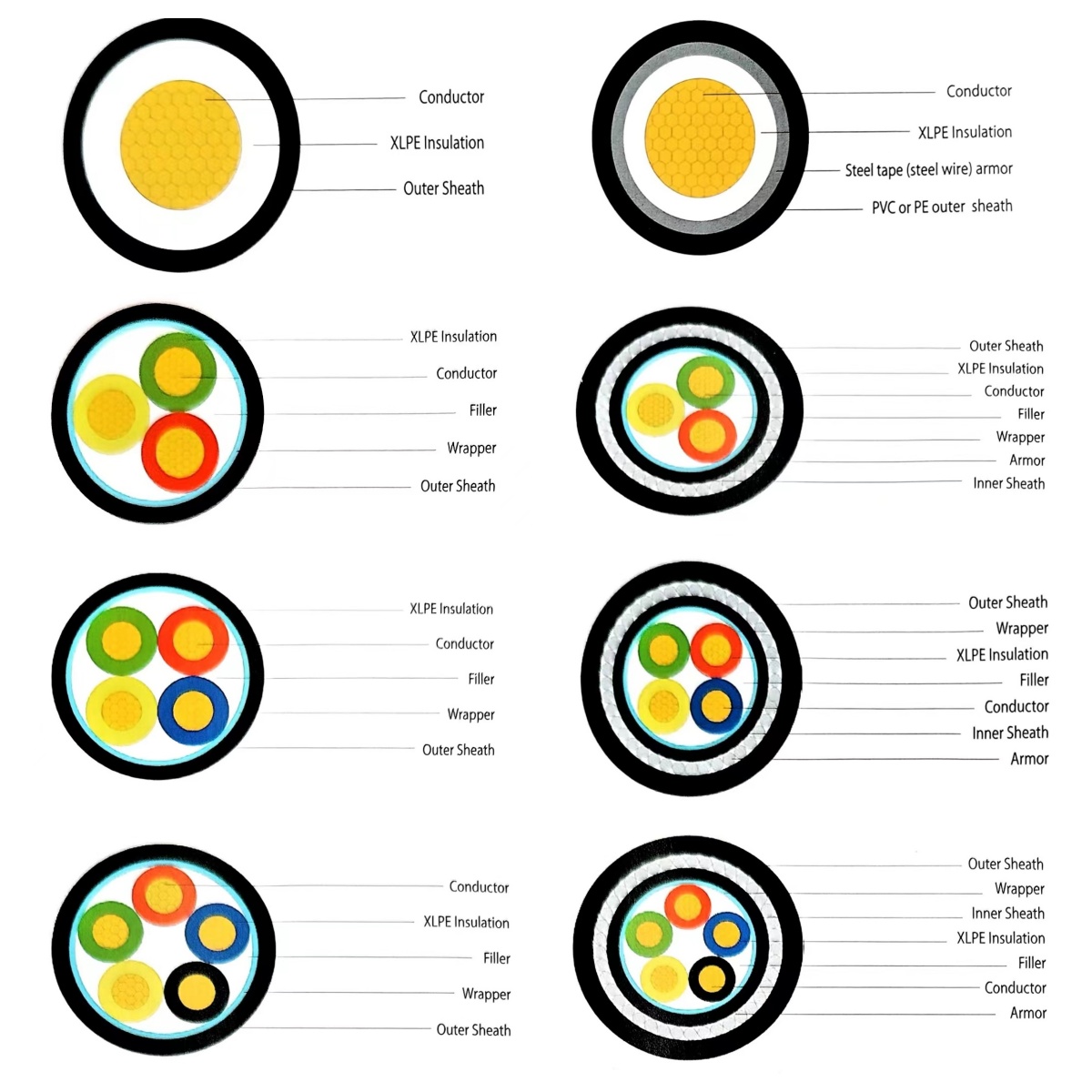
In terms of style design, all three types of cables have a circular
Multi-Core structure. The conductor is tightly wrapped by the insulation layer, and then multiple
Insulated Wire cores are stranded together according to a certain stranding method to form a cable core. The stranding method can make the cable have good
Flexibility, which is convenient for laying and bending in narrow spaces. The outer part of the cable core is wrapped with a sheath layer to form a complete cable structure.
The color design of the cable also has clear specifications, which is convenient for identification and installation. Generally speaking, insulated wire cores of different phases use different colors. For example, phase wires are often yellow, green, and red, neutral wires are blue or black, and
Ground Wires are yellow-green 双色. This color distinction can help installers quickly and accurately connect wires, avoiding mistakes. The color of the sheath layer varies according to the model. The sheath layer of VVG cables is mostly black; the sheath layer of VVGng cables is black and may have special marks to distinguish its UV resistance; the sheath layer of VVGNG-FRLS cables has various colors, commonly gray, white, etc., and some models will also be printed with low-smoke halogen-free flame-retardant marks on the surface of the sheath layer.
In addition, the surfaces of the three types of cables are relatively smooth, which not only facilitates laying through pipes or cable trays but also reduces friction with other objects, reducing the risk of damage to the sheath layer. In terms of structure, they all have high roundness, ensuring that the cable is evenly stressed when bent, and prolonging the service life.
(4) Production Process
The production process of 660/1100V VVG, VVGng, and VVGNG-FRLS series copper power cables is rigorous and complex. Each link has an important impact on product quality. Cables of different models have both commonalities and differences in production processes due to different performance requirements.
The production process of the conductor is a common basic link for the three types of cables. First, high-purity electrolytic copper ingots are smelted to remove impurities, obtaining copper liquid that meets the purity requirements. The copper liquid is cast into copper rods through a continuous casting machine. During the casting process, the temperature and cooling speed are strictly controlled to ensure that the grain structure of the copper rods is uniform and the mechanical properties are good. The copper rod is drawn into
Copper Wires of the required diameter through multiple wire drawing processes. During the wire drawing process, special lubricants are used to reduce friction between the copper wire and the die, avoid damage to the surface of the copper wire, and control the wire drawing speed and tension to ensure the dimensional accuracy and stable mechanical properties of the copper wire. The drawn copper wire needs to be annealed. The copper wire is heated to a certain temperature (usually 300-500℃) and then slowly cooled to eliminate internal stress generated during the wire drawing process, improving the flexibility and conductivity of the copper wire. Finally, according to the required cross-sectional area, multiple copper wires are stranded together to form a conductor. During the stranding process, the roundness and tightness of the conductor are ensured.
The insulation layer extrusion process varies with cable models. For VVG and VVGng cables, the insulation layer material is PVC. First, PVC resin is mixed with stabilizers, plasticizers, and other additives in proportion, and then added to the extruder. In the extruder, the material is melted and plasticized through heating and the shearing action of the screw, and evenly coated on the surface of the conductor through an extrusion die to form an insulation layer. During the extrusion process, the temperature (usually 160-190℃), pressure, and speed are accurately controlled to ensure that the insulation layer has uniform thickness, a smooth surface, and is tightly bonded to the conductor. For VVGNG-FRLS cables, the insulation layer is a low-smoke halogen-free flame-retardant material (such as XLPE). Its extrusion process is similar to that of PVC, but the melting temperature and extrusion parameters of the material are different, and the temperature is usually higher (200-250℃) to ensure that the low-smoke halogen-free material is fully plasticized and has a good coating effect.
The cable core stranding process is the process of combining multiple insulated wire cores into a cable core. For the three types of cables, first, the insulated wire cores are inspected for appearance and size to ensure qualified quality. Then, according to the number of cores and specifications, the insulated wire cores are stranded on a stranding machine according to a certain stranding direction and pitch. The size of the stranding pitch will affect the flexibility and structural stability of the cable, which is generally determined according to the outer diameter of the cable, usually 10-20 times the outer diameter of the cable. During the stranding process, the tension of each wire core is controlled to make it evenly stressed, avoiding loosening, twisting, and other phenomena. For some large cross-sectional area cables, filling materials (such as polypropylene rope) will be added in the middle of the cable core during the stranding process to ensure the roundness of the cable core.
The sheath layer extrusion process is the last key process in cable production. Cables of different models have different sheath layer materials and different processes. The sheath layer of VVG cables is PVC. Its extrusion process is similar to that of the insulation layer. The mixed PVC material is added to the extruder, melted and plasticized, and then coated on the outside of the cable core through a die to form a sheath layer. The extrusion parameters are controlled to ensure the quality of the sheath layer. The sheath layer of VVGng cables is PVC added with anti-UV additives. The anti-UV additives need to be added in proportion during the material mixing stage. The rest of the extrusion process is basically the same as that of the sheath layer of VVG cables, but the extrusion temperature and other parameters may need to be fine-tuned to ensure that the performance of the anti-UV additives is fully exerted. The sheath layer of VVGNG-FRLS cables is a low-smoke halogen-free flame-retardant polyolefin material. The temperature during extrusion is relatively high (200-230℃). It is necessary to accurately control the temperature and pressure to ensure that the material is evenly coated on the cable core, and at the same time ensure the flame-retardant performance and mechanical strength of the sheath layer.
In each link of the production process, strict quality inspection is required. Including the detection of conductor diameter and resistivity; the detection of the thickness, appearance, and voltage resistance performance of the insulation layer and sheath layer; the detection of the stranding quality of the cable core, etc. For VVGNG-FRLS cables, flame retardant performance tests, such as vertical burning tests, smoke density tests, toxicity tests, etc., are also required to ensure that they meet relevant standards. Only cables that pass all tests can enter the next process and finally leave the factory for sale.
II. From the Perspective of General Product Information
(1) Packaging
The packaging design of 660/1100V VVG, VVGng, and VVGNG-FRLS series copper power cables fully considers the needs of protecting products, facilitating transportation and storage, and also complies with relevant specifications of the Russian market.
For cables with a long length (usually 100 meters and above), cable reels are generally used for packaging. There are two types of cable reels: wooden and steel. Wooden cable reels have low cost, are made of high-quality hardwood, have certain strength and toughness, and can bear the weight of the cable. Its structure includes discs on both sides and a central shaft cylinder. The discs are provided with reinforcing ribs to enhance the load-bearing capacity. The diameter of the shaft cylinder is designed according to the bending radius requirements of the cable to ensure that the cable will not be damaged due to excessive bending during winding. The surface of the wooden cable reel is treated with anti-corrosion, which can resist the impact of humid environment to a certain extent. Steel cable reels have higher strength and durability and are suitable for large cables or long-distance transportation. Steel cable reels are made of high-quality steel by welding, and the surface is treated with anti-rust (such as painting or galvanizing), which can effectively prevent rust. Whether it is a wooden or steel cable reel, before winding the cable, a layer of plastic film will be wrapped around the outer layer of the cable to play a role in moisture and dust prevention. For cables such as VVGNG-FRLS that have higher requirements for storage environments, a layer of moisture-proof paper will be wrapped outside the plastic film to further enhance the moisture-proof effect.
The cable is wound neatly and orderly on the cable reel, with each circle arranged closely to avoid crossing and overlapping. After winding, the cable is fixed on the cable reel with high-strength plastic strapping to prevent the cable from loosening during transportation. A clear label will be affixed to the side of the cable reel, indicating the model, specification (such as VVG 4x10mm²), length, weight, production batch number, production date, manufacturer information, and the number of the Russian GOST standard it complies with, etc., for easy identification and traceability.
For short-length cables (usually 10 meters to 50 meters), coil packaging is adopted. The cable is wound into a circular coil, and the diameter of the coil is determined according to the cross-sectional area and length of the cable, generally between 30-60 cm. The outside of the coil is wrapped with plastic film and then put into a sturdy carton or woven bag. The carton or woven bag is also printed with detailed product information and labels, which is convenient for storage and transportation.
In the packaging process, some special measures will be taken according to the characteristics of the cable. For example, because VVGng cables are used outdoors, special attention will be paid to preventing the sheath layer from being scratched during transportation. A layer of buffer material (such as foam pad) may be added outside the cable reel or coil. The packaging of VVGNG-FRLS cables will emphasize their low-smoke halogen-free flame-retardant characteristics, with eye-catching labels on the labels, and the packaging materials will also try to choose environmentally friendly and non-flammable materials.
In addition, the packaging must comply with Russian transportation and warehousing standards to ensure that it can pass customs inspections smoothly during cross-border transportation, and occupy reasonable space during storage, which is convenient for handling and management.
(2) Transportation
The transportation of 660/1100V VVG, VVGng, VVGNG-FRLS series copper power cables needs to strictly follow relevant regulations to ensure that the products remain in good condition when they reach their destination.
In terms of transportation mode selection, road transportation, railway transportation or sea transportation can be adopted according to the transportation distance and quantity. For short-distance transportation in Russia, road transportation is more flexible, usually using trucks with rain shelters. During transportation, the cable reels or coils are fixed in the carriage to avoid movement and collision during driving. Steel wire ropes or fastening belts can be used to fix the cable reels at the fixed points of the carriage. For coil-packaged cables, they are stacked neatly and separated by partitions to prevent mutual extrusion.
For long-distance transportation or large-volume transportation, railway transportation is a more economical and stable choice. Cable reels or coils are loaded onto railway freight cars and also need to be firmly fixed to ensure that they do not shift during the bumpy railway transportation. For sea transportation, which is often used for exporting cables to Russia, the cable reels are loaded into containers. Special attention is paid to the distribution of weight to ensure the balance of the container. The cable reels are fixed to the container floor with twist locks or straps to prevent displacement during the voyage, which may be affected by rough seas and significant movement.
During transportation, attention must be paid to weather conditions. In case of rain, snow or other bad weather, the cables must be covered with waterproof tarpaulins to prevent moisture from entering the packaging and affecting the quality of the cables. For VVGNG-FRLS cables, which have strict requirements on moisture, additional moisture-proof measures can be taken, such as placing moisture-absorbing agents in the packaging.
The loading and unloading process is also crucial. Special lifting equipment (such as cranes, forklifts) must be used when loading and unloading cable reels to avoid manual handling that may cause damage to the cables or packaging. When lifting, the lifting tools must be connected to the designated lifting points of the cable reels to ensure stable lifting and prevent the cable reels from tilting or falling. For coil-packaged cables, they should be handled gently to avoid squeezing and deformation.
During the entire transportation process, it is necessary to track the transportation status of the goods in real time. Logistics companies should provide timely feedback on the location and condition of the goods to the manufacturer and the customer, so that both parties can grasp the transportation progress. If any abnormal situation is found (such as damage to the packaging, delay in transportation), it should be dealt with in a timely manner and reported to the relevant parties.
(3) Shipping
The shipping process of 660/1100V VVG, VVGng, VVGNG-FRLS series copper power cables is a systematic work that involves multiple links such as order processing, goods preparation, document preparation, and customs declaration, to ensure that the products can be delivered to Russian customers on time and smoothly.
After receiving the customer's order, the manufacturer first confirms the order details, including the model, specification, quantity, delivery address, and delivery time of the cable. Then, the warehouse department is arranged to check the inventory. If there is stock, the goods are prepared according to the order requirements; if there is no stock, the production plan is formulated in time to organize production to ensure that the goods are prepared before the delivery deadline.
In terms of document preparation, since it involves export to Russia, a series of documents must be prepared in accordance with Russian customs regulations and international trade practices. These documents include commercial invoices, packing lists, bills of lading, certificates of origin, and product quality certificates (in compliance with Russian GOST standards). The content of the documents must be accurate and consistent to avoid problems in customs clearance. For VVGNG-FRLS cables, additional flame-retardant performance test reports may be required to prove that the product meets the relevant fire safety standards in Russia.
Customs declaration is a key link in the shipping process. The manufacturer or the entrusted customs broker shall handle the export customs declaration procedures in accordance with the regulations, truthfully declare the product information, and pay the relevant taxes and fees. At the same time, it is necessary to understand the latest customs policies and regulations of Russia to ensure that the customs declaration documents and procedures are in line with the requirements, so as to avoid delays in customs clearance.
After the goods are loaded and the documents are complete, the shipping company is notified to arrange the shipment. The manufacturer will keep in close contact with the shipping company to track the voyage or transportation schedule. Once the goods arrive at the Russian port or destination, the relevant documents are sent to the customer in a timely manner so that the customer can handle the import customs clearance procedures smoothly.
In addition, after the goods are shipped, the manufacturer will also provide the customer with a tracking number or a waybill number, so that the customer can query the transportation status of the goods by themselves. If the customer encounters any problems in the process of receiving the goods, the manufacturer will actively coordinate with the logistics company and the customer to solve them.
(4) Samples
To help Russian customers better understand the performance and quality of 660/1100V VVG, VVGng, VVGNG-FRLS series copper power cables, the manufacturer provides a sample service, allowing customers to conduct tests and evaluations before placing a large order.
Customers can apply for samples through the manufacturer's sales staff or official website. When applying, they need to provide basic information such as the required model, specification, and quantity of samples, as well as the company name, contact person, and contact information. The manufacturer will confirm the sample application and related matters (such as sample fee, freight) with the customer. In general, the sample fee can be refunded when the customer places a large order, and the freight is usually borne by the customer.
The samples provided are produced in the same batch as the formal products, using the same materials and production processes, to ensure that the samples can truly reflect the performance and quality of the formal products. The length of the sample is usually 1-5 meters, which is convenient for customers to carry out tests such as appearance inspection, size measurement, and electrical performance testing. For VVGNG-FRLS cables, samples will also include flame-retardant performance test reports to help customers understand their flame-retardant characteristics.
The packaging of samples is simple and practical, usually using small cartons or plastic bags, which are marked with the product model, specification, production batch number and other information. Samples are shipped through international express or logistics channels, and the manufacturer will provide the customer with a tracking number to facilitate the customer to query the delivery status.
After receiving the samples, if the customer has any questions about the samples or needs technical support, the manufacturer's technical staff will provide timely answers and guidance to help the customer better understand the product.
(5) After-sales Service
The manufacturer of 660/1100V VVG, VVGng, VVGNG-FRLS series copper power cables attaches great importance to after-sales service and provides comprehensive after-sales support for Russian customers to solve problems encountered in the use of products.
The warranty period of the product is generally 1-3 years from the date of delivery, depending on the model and use environment of the cable. During the warranty period, if the product has quality problems due to material defects or manufacturing errors, the manufacturer will provide free repair or replacement services. However, damage caused by improper use, installation, or man-made damage is not covered by the warranty.
If the customer encounters problems during the installation and use of the cable, they can contact the manufacturer's after-sales service department through phone, email, or other means. The after-sales staff will reply to the customer's inquiry in a timely manner and provide technical guidance. For complex problems, the manufacturer can send technical personnel to the customer's site for on-site debugging and problem-solving, but the relevant travel expenses and service fees may need to be borne by the customer, unless otherwise specified in the contract.
The manufacturer will also collect customer feedback on the product, including the use effect, performance, and problems encountered, so as to continuously improve the product and service quality. In addition, the manufacturer can provide relevant technical training for customers, such as cable installation methods, maintenance knowledge, etc., to help customers better use and maintain the product.
For customers who need to replace parts or repair cables after the warranty period, the manufacturer can also provide paid repair services and supply genuine parts to ensure the normal use of the product.


 Español
 Portugues
 Pусский
 Français
 العربية
 ไทย
ไทย Türk dili
 Indonesia
 Tiếng Việt



 Phone
Phone E-mail